All the bits for the final version of the bevel gear project are cut out and ready to go. I'll complete the photography in the morning.

Each of the two bevels is based on an arc of paper. The one pictured here is the sixteen tooth bevel. The teeth are also based on an arc, they curve round fairly tightly so I have divided them into blocks, each block being used to make four teeth. The left hand arrows show the grey areas where the teeth glue down.
I've had no internet for the past few days (grrr!) so I've being availing myself of the free wifi at the Coffee Kitchen in Cockermouth. I'm the JK Rowling of the paper engineering world. Without the money obviously, and fewer wizards. Less writing as well. In fact - forget that. I'm the Rob Ives of the paper engineering world and I like a good coffee.
Keep up to date: Receive the latest blog post by email
Rate this post:
Sssnake looking for a new home!
It's been a while since I run one of these give-aways so as you can imagine, robives.com towers is overflowing with paper models and #truelove is on the war path.
Starting with the Snnnake model I'll be running a weekly draw for a little while finding new homes for some of these waifs and strays. If you could find it in your heart to give a home to the Sssnake, just add a comment to this blog post. I'll draw a name out of the hat of special relativity on 27th May.
This give-away is open to all paid members of robives.com, thanks for signing up!
Keep up to date: Receive the latest blog post by email
Rate this post:

I have the bevel gears for my gear zine designed and ready to go, I just need a frame to hold them in position. I've started with a box, 15mm deep, with triangular tubes next to the axle holes to stop the sides from flexing. Thinking about now I realise I only need stiffeners on the surface next to the gear, that will be a modification for the next version.

The large bevel gear, being so wide, is still prone to some side to side movement so I've placed a couple of stops near the outer edge of the gear to limit its movement.

With the end pieces in place the gears are held securely in position and rotate against each other quite nicely.
Keep up to date: Receive the latest blog post by email
Rate this post:
Become a Member for free
access to this and other files on the site.See the Membership page for more details.
Already a Member? Log in Here

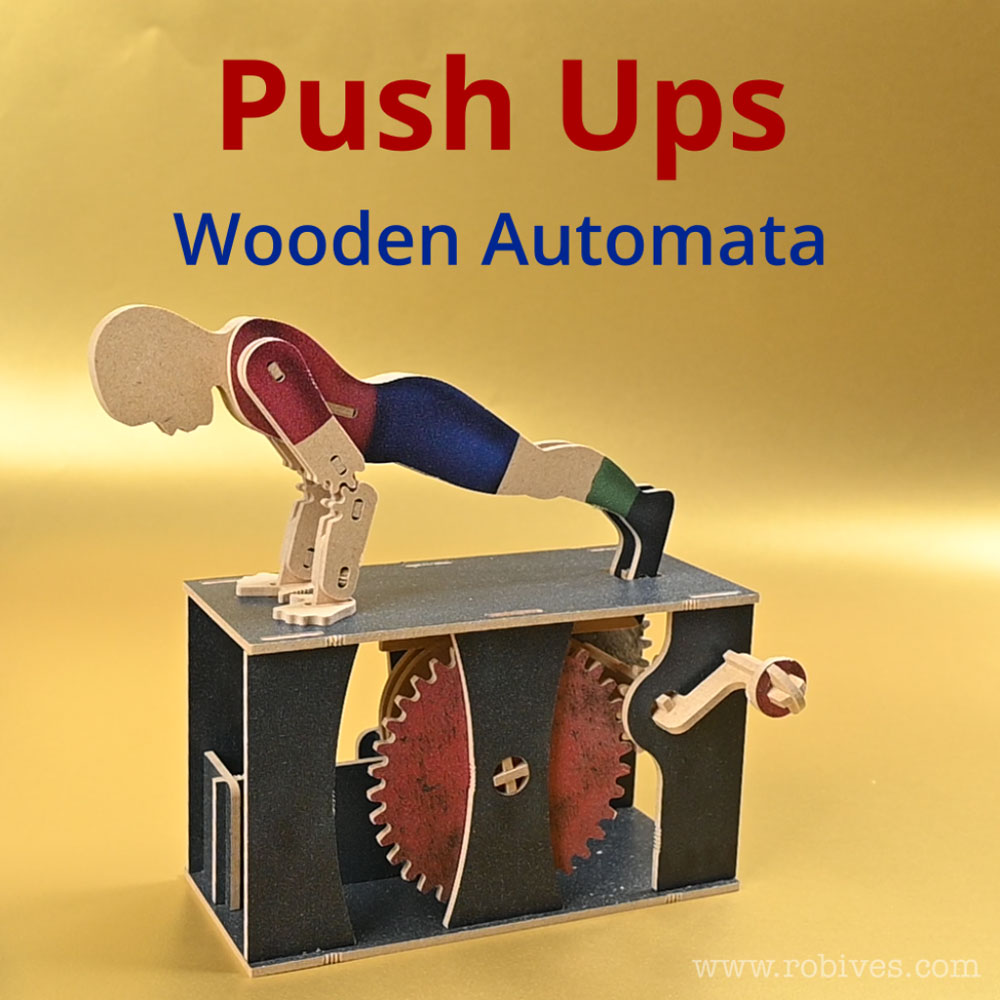
Paper Press Ups - Download and make!
Turn the handle on this crank powered model and the paper robot practices his press ups.
Members can download and make the parts for this model for free, thanks for signing up. Non members can download it for £2.50 at the link.

The parts are on four sheets. In the file there is a color version and a line only version. If you are printing the colour version you will need to print each sheet on both sides. Print out the parts on one side, flip the card over and return it to the printer to print the other side. Use 230gsm/67lb thin card for this model.

To make the push rod ends fold over the card to make double thickness card and glue it down. Once the glue is dry carefully cut out the holes.

Then cut out the parts.

Make up the pins by rolling them round so that they end lines up exactly with the triangle arrows then glue down the ends.

Repeat this process with the three pins and the should tube.

Make up the two crank offsets as shown in the picture.

Glue the shorter pin into the short end of one of the crank offsets.
Thread the two push rod ends onto the pin.

Assemble the push rod.

Glue the push rod ends to the push rod making sure that it is kept square to the pin.

Finish off the crank assembly by gluing on he second crank offset then gluing the two longer pins into place making sure to push them completely home.

Glue up the two box sides making right angled tube sections.

Glue in the two box ends.
Assemble the box top stiffener triangle tube and glue it so that it just touches the hinge crease.

The box, ready for the next step.

Fold up the box with the crank in place as shown.

Glue down all the flaps and tabs to complete the box.

Assemble the handle as shown above.

Glue the handle to the crank shaft.

Assemble the upper and then glue the arm side covers into place, use the single and double dots to help with alignment.

Assemble the forearms. Notice that the long tab is a valley fold.

Glue the upper and lower arms together. Glue the elbow onto the side of the arm without the square hole.

Roll round and assemble each leg. glue them together.

Assemble the feet.

Glue the feet to the leg. Glue round the long tabs into the leg.

Assemble the foot push bar and glue it into the foot.

Glue the body support to the two grey areas on the legs.

Fold the tab in the top of the box downwards into the box. Thread the foot push bar down through the hole in the top of the box and glue it to the box tab.
Glue the push rod to the end of the foot push bar.

Roll the slip ring round the shoulder and glue it round onto itself so that it is a tight fit but is free to rotate.

Assemble the body box.
Fit the shoulder tube into the box and glue it into place ensuring that the slip ring can still rotate.

Assemble the neck tube then glue it to the slip ring.

Fit the body to the legs.

Assemble the square shoulder pin

Fit the hands into the arms. The thumb should be on the same side as the square hole.

Thread the square pin through the shoulder tube, glue the two arms to the pin.

Glue the palms to the top of the box. Complete the model by assembling the head and gluing it to the neck then gluing on the eyes.

Turn the handle to exercise your robot!
Keep up to date: Receive the latest blog post by email
Rate this post:

I do most of my design in Adobe Illustrator. When I'm designing a part I usually make up the parts with boxes, these are quick to draw and easy to edit. The piece here is the upper arm. It is a little rough and ready but is the layout I'm using for the final model. Now to convert it into a usable piece of artwork.

The first thing I added are the guidelines to construct the tabs on the top of the arm piece. I made a V shaped line on either side of a central line...

...then copied it six times rotating it 30° each time.

With the guidelines faded into the background I drew on the tabs. The guidelines ensured that they were neat and evenly spaced.

I then copied the tabs and modified them to fit above the right hand side of the arm. I then completed the outline of the part so that it is a single line incorporating both sets of tabs.

To finish off the part I added the dashed fold lines and grey areas where glue is to be applied.

I then printed out the part, scored the crease lines and cut it out.

And here's the finished thing. Once I'm happy that the rest model goes together properly I'll add colour to the Illustrator file.

The rest of the parts with our new part in place.
Keep up to date: Receive the latest blog post by email
Rate this post:

One final tweak to the arms, I've added an extended cover to the elbow so that even as the arm is fully folded there is no gap in the side view of the arm.

I fitted a slip ring round the shoulder tube to act as a mounting point for the neck. So long as it is a tight fit it should hold the head into whatever position it is placed.

I'll add proper artwork onto the foot along the lines of this pencil version.

And here is the completed model with the head fitted into place. Last step, colour. I'll leave that until tomorrow, time for a quick strum on the old guitar.
Keep up to date: Receive the latest blog post by email
Rate this post:

Well I must have made a dozen (or metric equivalent) different size arms trying to get the proportions right on the push up model. Frustrating but sometimes that's just the way it goes. This is one of the failed efforts.

And another - this time using an I beam rather than a box section.

Too long.

Arm grave yard.

I'm finally sorted. Just the head to go. I think I'll add a semi-pose-able head onto the circular shoulder tube. I hope that goes together a bit quicker!
Keep up to date: Receive the latest blog post by email
Rate this post:

I've put together a box with sides as cut-away as possible so that you can see the mechanism at work. Triangular paper tubes help keep the structure surprisingly strong.

Rather than a circular axle running through cut out circular holes (left) I've opted for a rolled tube fitted to the top of the body with a square pin running through it. (Right) This has the double advantage of reducing the number of circular holes that need cutting out and square pin fitting nicely to the arm top.

End view of the crank.
Keep up to date: Receive the latest blog post by email
Rate this post:
If you have a moment, go check out this blog. Ludd Stuff - Things I Make for the Fun of it. I was going to do longer post with pictures and everything until I read the unfriendly copyright notice. Still, go and have a look. It's well worth a visit!
Keep up to date: Receive the latest blog post by email
Rate this post:
Smelter and Coolio both drew my attention to this paper model of a push up character on a Japanese karakuri website.

Unfortunately it is impossible to tell from the picture just how it is driven. One thing is for certain though, the drive is through the feet, not the arms just as in my proposed model.

This plastic, wind up model which I found on the Hawkin's website has powered arms.

Master automata maker Paul Spooner produced this delightful model some years ago, again driven via the feet.

This time a circular cam with a slot round its circumference pulls on a string as it is turned, in turn this pulls the feet and lifts the body.

Pneumatics power...
...and hydraulics power and both beyond the scope of paper projects. So far.

Cam power, however, is not as per this model that I produced for a company some years ago which appears to be no longer in print.

So we come back to the design I'm working on now. It is fascinating to see how your approach to a similar problem changes over the years.
Keep up to date: Receive the latest blog post by email
Rate this post: