Crank
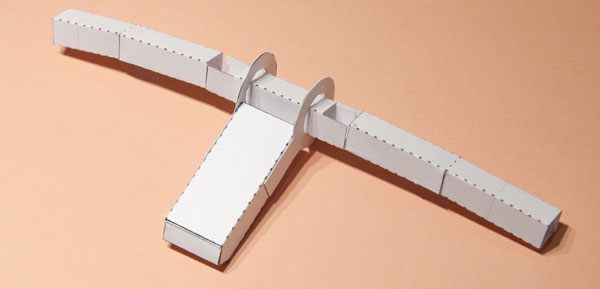
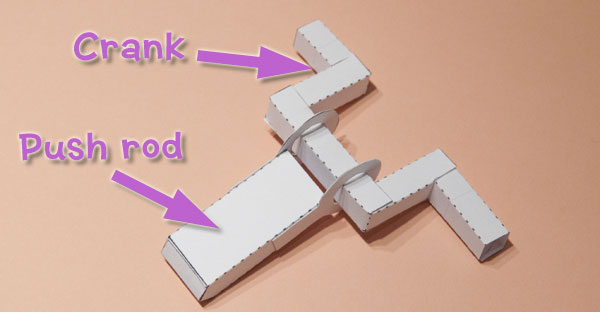
The crank is used to convert rotary motion to reciprocating or oscillating motion. With careful timing it can also be used to convert motion the other way... from reciprocating to rotary.
The throw of the reciprocating motion is determined by the offset of the crank
USEFUL LINK:
Make your own working crank mechanism. Download and make this model and find out about cranks first hand. More info...


Comments
im doing this in tech in school its really hard
robives
Anything you want to know? I might be able to help.
Rob
Aha, so are we. It's so hard!
I don't understand most of it :P
DCJ
Hello Rob
I am a Technology teacher in New Zealand who teaches a Automata unit to yr 9 students (13-14 yrs old). I have found your resources to be fantastic in helping the students to understand mechanisms. The photo is a Automaton by one of my students, it is a 'Shuffler' ('shuffle' is a type of dance) and it uses a crank and lever mechanism.
robives
Fantastic! Thanks for sending in the picture, that shuffler looks great.
hi rob, do you know what type of movement this mechanism moves in please???? x
robives
I'm presuming you are talking about the photo sent on by DCJ ? I'm not sure but it looks like it might be a crank slider. Wire crank in the box, wire push rod from the crank, up through a hole in the box top connected to the dancer. Is that right DCJ?
Hey just wanted to say thankyou very much for this extremely usefull Website, im using it to help me gain a good understanding of that different type of mechanisms that i could feature in the product that im designing. this site has really helped me with my tech coursework, keep up the good work !!
robives
Thanks! Glad to be of service :-)
hi rob im making a golf ball dispenser and i was wondering if u knew wat type of mechanism i could use so that one ball comes out at a time?
Hi there! I would just like to ask, is crank a suitable mechanism on a model that has a train track with a train going from left to right and vice versa?
robives
You could use a crank to make a train go back and forth but the motion would be limited to the length of throw of the crank. A pulley or belt drive might be a better solution
DCJ
Yes, the mechanism is a crank, the wire pass thru a restricted hole that makes the legs move in a circular movement. The motion of the legs is quick in its lateral movement giving the 'shuffler / jerking' effect to the dance.
On an aside note, the school subscription sounds like a great idea.
yasminh
Hi Rob,
I need to design a mechanism that convert reciprocating motion to rotary motion. I have several ideas for
the other way, but this conversion is a little difficult.
It says above, that With careful timing the crank can be used to convert that kind of motion.
What does it mean? How can I do that? if the motion is coming from the left, the wheel is not doing a
complete round.
thanks!
robives
@yasminh This is basically what a piston does. You are correct that the motion is not powered all the way round. Push the piston and the wheel will rotate half way round, the piston then relies on the momentum of the rotating wheel to keep it moving back to the start position.
Hey robives, your website is great, it is so simple and cuts out all the bull.
Have you considered making an electronics site ?
What kind of mechanism would I need for a flying pig?
robives
The Flying Pig uses a crank slider mechanism.
rotary motion transfered to reciprocating motion as I understand it.
i don't get this
Gah! I thought I already found what I was looking for in the quick return mechanism but this crank animation is very similar. In the animation above where the movement is converted to swinging an arc, is the left-right to right-left movement swinging at the same rate? or is one slower than the other?
Between this and the quick return mechanism...(using the animation above) is the left-right to right-left motion moving at the same rate?
heya im stuck on drawing a diagram for my flying horse im using the crank any clues?
You might be better with a crank slider - RI
LM
Rob, I am doing a school project on mechanisms, but I can't think or find any examples of a product (object/item) which uses this mechanism. Can you help me?
LM
P.S. This website is so cool and has been a great help!
How about a mechanical hacksaw or windscreen wiper blades?- RI
LM
Thank you so much!
LM
Is there a crank on a bike and where is it and what is its function
Thanks :)
The crank on the bike is the pedal. It is used to convert downward force from the leg into rotary motion in the wheels - RI
Rob could you tell me some examples, in which a crank is used in.
Bicycle pedal, petrol and steam engines, mechanical hacksaw, windscreen wipers... - RI
Hi Rob i just want to say that you are a amazing person with great taste in mechanisms and clothing.
P.S i like your glasses
P.S.S what are cranks used in
yours sincerly joseph
thank you for this great site. i am 12 years old and doing automata in D.T. and this perfect for me, and i highly recommend this site to any one doing automata.
Hi Rob I need to convert circular motion to vertical straight up and down movement, how do I do this?
Try using a crank mechanism like the video clip at the top of the page, turn it through 90 degrees and the piston would move up and down rather than side to side. - RI